Sunday, 29 April 2012

The Longer Pose

My final drawing in this section is the longer pose and again I had some limitations as the model was in my life class and so I had one hour to complete the task.  I wasn't quite finished and I should have worked more quickly, I used conte crayon sanguine and I love the colour, I used the head as my measurement guide.
I also looked at the drawings of Antoine Watteau as he used red chalk for many of his drawings and the colour is soft and expressive.
Jean Antoine Watteau 1684-1721 Study of a woman seen from the back
Bridgeman Educational Library
Study of a nude woman by Jean Antoine Watteau
Bridgeman Educational Library
The first picture with the woman dressed and corsetted sitting erect due to her attire is in complete contrast to the nude woman curvacious and mobile showing movement and a different type of energy. 

Proportions: Exercise Quick Poses

I have never attempted Life Drawing so joining a class was exciting, intimidating and very challenging.  The main problem that I encountered was the lighting, it was overhead strip lighting so it was difficult to define the tone and work out where the main body of light came from.  I also had to fit my exercises around what the class had been set up to do which at times was a bit frustrating.  The hardest thing for me was the quick sketching as I am slow and to start with there was very little achieved  other than head and shoulders.  Eventually, I realised that I needed to simplify what I was looking at and began to look at angles and shapes and this was quite a turning point in my development.  I also realised the crucial importance of negative space and how that has helped me in finding proportion and form.
Quick Poses
These were two minute poses done from different positions.  These particular sketches I did with out much thinking about detail and the foreshortening was quite a revelation to me I suddenly realised when I used shape and negative space it worked.  I felt totally elated I had suddenly got it! The standing poses I tried to work out proportion and angles and used the head as a measurement.

I really enjoyed the foreshortening and on the two lying poses it was the first time that I have been sucessful in achieving this type of foreshortening I felt quite excited.
I continued with some 10min poses one or two were just over the 10mins and one was under and I have played about with various mediuns.
I started with a pen and ink drawing as I prefer this to black liner but it was quite difficult using this medium on an easel as the ink is flowing the wrong way. I used coloured ink to show tone.
I liked the simplistic effect but I feel I must be more open and freer in the drawing to make a more interesting picture.
The next sketch I did left handed and I was amazed how accurate the drawing was.  I have done one other left handed drawing in the past and again the likeness was good, my sons are dyslexic and it comes from my side of the family so whether this has a bearing on my left laterallity I do not know.  I have darkened the outline with my left hand so that it would stand out on the photograph.
I used charcoal in the next picture and my main criticism is that I took too long over the drawing, it looks laboured and I didn't fell confident in the drawing of the model.  I like charcoal very much and use it a lot in life drawing as it frees you up which I need to do to improve my drawing.


The next two sketches I did on black paper using pastels and I found that this was fun and quick I particularly like the cross legged pose as I just drew the pose as quickly as possible and blocked in tone with different colours not bothering about realism but shape.  It was surprising and not the usual way I approach my work.  I need to expand on this and not be so worried about mistakes or failures.

My final two pictures in this section one in oil pastels where again I have just experimented with colour and the other picture is pastel on pastelmat.

What I have learned from quick sketches is that I need to be more relaxed use my whole arm and try to concentrate on angles, gesture and be bolder with my mark making.


Monday, 16 April 2012

Project Structure

I have decided to jump to this section before I continue to do the other exercises because I have a real need to understand the anatomy and muscle structure of the body. I have the greatest of problems with this and so I have tackled it in my own way to gain maximum benefit from the assignment. I have started with the structure section as this makes more sense to me.  So I have begun drawing anatomical pictures and then tried drawing these areas from life studies, and as always looking at other artists studies has been invaluable and hopefully this will be demonstrated in my log.
I started with the bones of the hand as I have always had trouble drawing hands and I then drew my own hands and also tried foreshortening.

I have found this exercise very useful and so this has encouraged me to continue on the anatomy study drawings.  What I have gained so far is that the proportion of the hand and size is important, i.e. the palm of the hand is approximately the same length and width as the middle finger. This for me is quite a discovery as it has helped me to understand how to tackle hands and give consideration to the size of the palm which is roughly square in shape when the hand is open.
Encouraged and excited by the results I continued along the anatomy theme by drawing the bones of the feet and again I have drawn some foot studies from life and it is amazing whilst drawing I became aware of the structures giving form to the foot.  I also noticed that the medial ankle bone is slightly higher than the lateral ankle bone and this I try to remember and look for in my life drawing.

I then progressed to the shoulder and arm and this has particularly helped me draw studies at different angles because  the muscles are more defined than the bone structure.  With the drawing of feet and hands the boney prominances are more apparent where as with the arms and shoulder the muscle defines shape.

My next study was the pelvis and legs and it is important to understand that the positioning of the pelvic girdle in relation to weight distribution.  Whether walking or running the angle of the pelvis changes which has a knock on effect on the torso and shoulder girdle.
All the anatomy drawings have been copied from the Human Anatomy for Artists illustrated by Andras Szunyoghy and written by Dr. Gyorgy Feher published by Konemann 2006.  
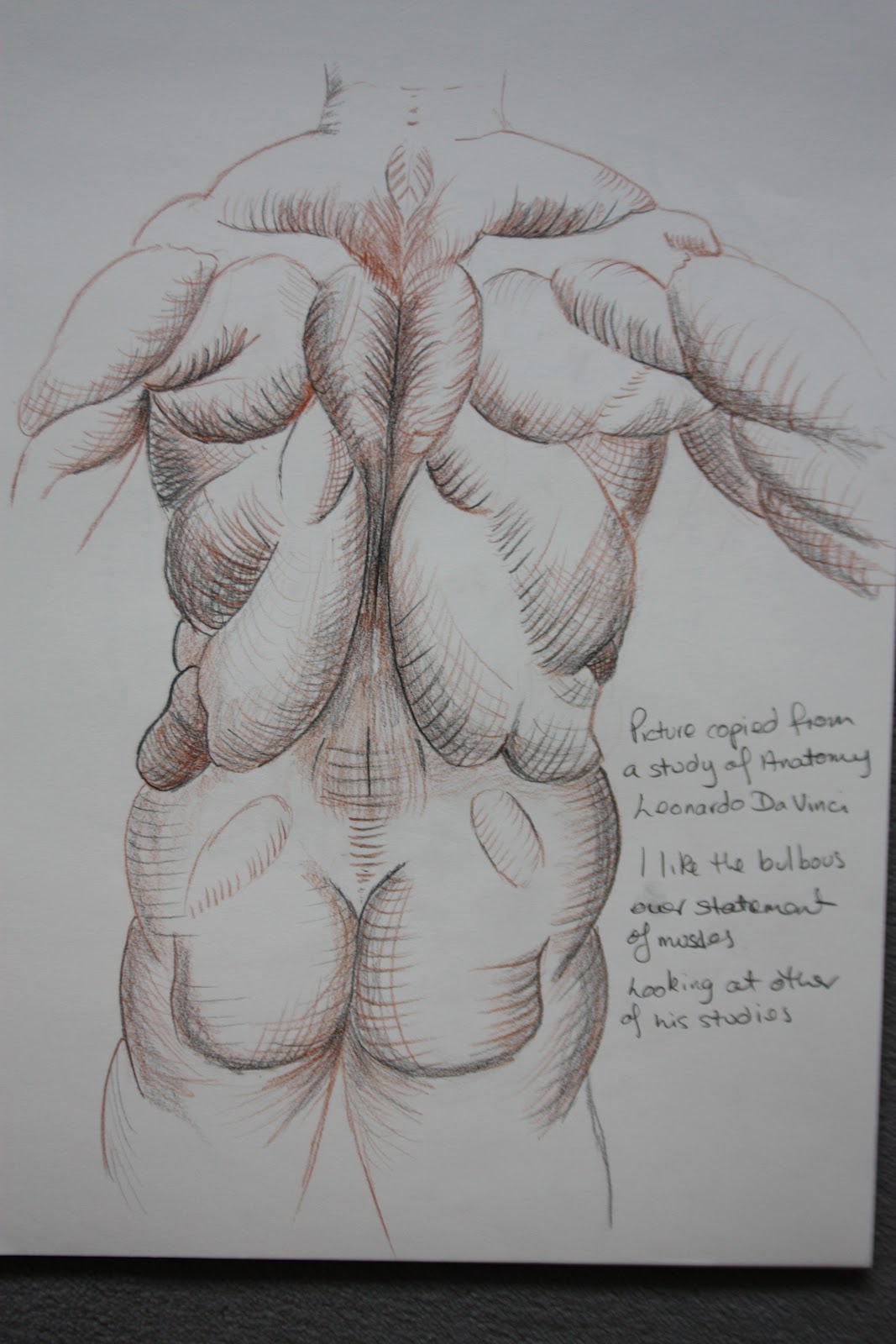
I looked at some drawings by Leonardo da Vinci "The Graphic Work", by Frank Zollner and Johannes Nathan, and copied his studies of the muscles of the back.  I like the way he exagerated them which gives them a Grecian God like style.

 I am gaining so much from these studies that I shall continue drawing anatomical drawings to help me gain a better understanding of the form and shape of the human body. 

Tuesday, 18 October 2011

2nd Assignment


I have chosen objects for my 2nd assignment that mean something to me.  The driftwood, fish netting and shells were all collected by my family this year on holiday in North Devon where we went to celebrate my birthday.  I have used the birthday card made by my youngest Granddaughter. I love this piece of driftwood it is such a great shape.  I started to think about composition and what media I would use.  I have chosen coloured pencils as I feel I am getting to grips with them. 
I also played about with colour and made notes of the colours I used.  The practise piece I decided to do in soft pastel on pastelmat as I feel more at home with them. I also chose some flowers from the garden and put them in a glass vase to include into the picture.
I felt after looking at the finished practise piece that there was a lot of space on the right hand side and that it just looked uncomfortable so at the eleventh hour I decided to put the birthday card on the wall and a coffee mug to the right of the netting and I think that it improves the composition.

The main problem I found with this drawing was not to loose any depth particularly on the driftwood in the foreground.  I wanted to maintain the light and the darks and did not want two areas of similar tone to fight against each other.  The netting was tricky as the drawing of the netting was complicated and following the net and the knots was laborious but I wanted to achieve the sense for the netting going towards the background with the piece of drift wood.  I have kept the table foreground simple as so much is going on elsewhere I didn't want to loose anything in being over fussy with it.

Drawing animals

Having chosen to draw my friends cat which is a 14yr old half Siamese and half Devonshire Rex called Boris.  Thinking being an old cat he would be less active and easier to draw which was a big misapprehension as he was as lively as a kitten.  His fur was difficult to draw as he doesn't moult and the fur is curly and wool like except for his face and tail which is smooth and short haired.  It lies in tufted lines and is extremely textural. He is bald on his abdomen and the skin lies in folds. His ears and eyes look too big for his face and he is a very unusual cat in looks and personality.  I firstly drew him in pencil to get the feel of his shape and didn't realise how hard this was going to be as he was so interested in what I was doing he was continually moving about.
The only way I found to capture a pose was to go for a basic shape quickly as you cannot worry about accuracy and I think I managed some poses in this way.
The next time I visited Boris I wanted to catch him in other poses so I tried with conte crayon and again it was difficult to get a consistant pose.
The final picture I did of Boris is in charcoal and I think that I have captured the texture of his coat. Even when he was sleeping he was constantly tucking his head in different postitions.  I enjoyed my time with Boris but you have to be patient and be willing to spend time just sitting and then siezing the moment.  I have copied animals from pictures and photographs but you see so much more from life and maybe the picture looks less accurate but I think you are more likely to catch the essence of the animal and not just the image.

The next exercise is a fish on a plate, which was very hard for me as I do not like fish and cannot touch them.  Having bought two herrings and a trout and arranged them on a plate with a help of a fish fearing friend I began to draw and colour them using water colour pencils.  Water colour pencils are quite hard to use and do not react in the same way as water colour paint as it doesn't move around a lot when water is added and if you apply too much water the colour can wash out and runs to the edge of the water line.  This could be useful if you want that effect.  Also colours are stronger when wet some more than others and in this exercise I should have tested this out on paper before I applied the pencil particularly when doing the shadow which is far too heavy.
Another consideration is weather, I work in a shed at the bottom of the garden and it gets hot in the summer and when I started the fish on one day and stored them in the fridge overnight which was fine first thing in the morning but by midday they were putrid.


Drawing animals is rewarding and frought with challenges, I tried to draw some New Forest ponies earlier in the year and found that I was chasing them all around the field.  I only achieved two reasonably sketches but since I have never drawn a horse before I was pleased with that.

Anatomical drawings of George Stubbs

A Brief History of George Stubbs


                                    A Self Portait of George Stubbs
                    http://www.bridgemaneducation.com/Search.aspx
George Stubbs was born in 1724 in Liverpool and he was the son of a currier.  He had little formal training in art although he was briefly a pupil of Sir Godfrey Kneller's assistant Hamlet Winstanley.  This training was enough to set himself up as a portrait painter where he worked in Wigan.  He was very interested in human anatomyand studied at the York County Hospital and he know enough about anatomy to give private lessons to medical students.  In 1751 he was comissioned to illustrate a book on midwifery by Dr John Burton.
In 1754 he went to Rome to reaffirm that his belief that nature was superior to art and although he did have a great liking of Italian art when he died some Italian works were found in his collection.  Whilst in Italy he became intrigued by the marble horse attacked by a lion in the courtyard of the Palazzo Senatorio in Rome. The author suggests that this is where his several paintings on this theme originated.

                         A Lion Attacking a Horse (oil on canvas) 1762
                       http://www.bridgemaneducation.com/Search.aspx
In 1756 he fathers a son George Townley Stubbs by Mary Spencer his common-law wife.  In 1750 the Jockey Club was and the breeding and training of racehorses became fashionable.  So in 17 58 Stubbs began to study the anatomy of horses in a farm house in Horkstow near Lincolnshire.  He used dead and decaying horses to disect and reconstruct skeletons in his quest to understand the anatomy more thoroughly.  He did all his own engravings for a book  called simply the Anatomy of the Horse and this enabled him to produce paintings of unsurpassed accuracy far exceeding his predessors James Seymour or John Wootton.
 Stubbs by William Gaunt Phaidon Press Limited 1977


Diagram from the Anatomy of the Horse
Whistlejacket was his most famous work and changes convention by having a plain background

                                   Whistlejacket 1762 (oil on canvas)
George Stubbs also painted exotic animals such as giraffs, lions, monkeys, tigers and rhinoceroses which he observed from private menageries.  He died at the age of 81 yrs on 10th July 1806
                           http://en.wikipedia.org/wiki/George_Stubbs
Stubbs's contribution througj the Anatomy of the Horse was an important piece of research and was vital to the understanding of the stucture of the horse.  The knowledge of  skeletal and muscle placing defines the shape of the horse.  The horse's coat in his paintings is short so the muscle and skeletal definition show through and the accuracy of his work is unchallenged.  He also added individualism to his horses as they all seem to have different expressions such as in the Mares and Foals painting


Mares and Foals without a background 1762
The most expensive Stubbs painting recently sold was Gimcrack on Newmarket Heath with a Trainer and Stable Lad and a Jockey  at Christies International in London on July 5th 2011 http://en.wikipedia.org/wiki/George_Stubbs


The Animal Drawings of Albrecht Durer and Leonardo da Vinci

I was asked to look at the drawings of animals of two masters and so I have chosen Durer and Da Vinci as I have already some previous research on these two artists I didn't focus on their animal drawings so I thought I would look into their work on animals.
Albrecht Durer
The Hare water colour on paper 1502
http://www.bridgemaneducation.com/ImageView.aspx?result=0&balid=311216
The Hare is a most precise drawing of an animal which is not surprising given Durers interest in proportion and anatomy.  The hare's coat is so real and the painstaking patience to paint and draw this animal is amazing.
Three studies of a Bull Finch water colour with gouache on paper.
http://www.bridgemaneducation.com/ImageView.aspx?result=0&balid=311216
 I chose the birds because of thedifficulties of drawing these creatures and getting the posture right.  They may have been caged so that it would make it easier to draw and of course keep them in one place.

Leonardo Da Vinci
Leonardo was said to have loved animals and according to this website he wrote 'The time will come when men such as I will look upon the murder of animals as they look upon the murder of men' http://petlvr.com/blog/2006/12/13/leonardo-da-vinci-leonardos-animals-part-1-of-2/
Rider on Rearing Horse http://www.bridgemaneducation.com/ImageView.aspx?result=0&balid=311216

This picture has such movement and it is all about the horse and not the rider.  The angry temperment of the horse is evident and the back legs have been skeletally exagerated, which makes me think that Leonardo has a very good grasp of the horse's anatomy and he can play about with the animal with out it looking out of context.


Study of Cats
Having just spent two days drawing cats I was delighted to find this drawing of Leonardo cats.  I love the poses and appreciate how difficult it is draw a restless animal.  He has them prowling and playing and he also has one with an elongated neck which looks dragon like, so he was playing around with their form and movement.